The conservation and restoration of waterlogged wood is the process undertaken by conservator-restorers of caring for and maintaining waterlogged wooden artefacts to preserve their form, and the information they contain. It covers the processes that can be taken by conservators, archaeologists, and other museum professionals to conserve waterlogged wood. This practice includes understanding the composition and agents of deterioration of waterlogged wood, as well as the preventive conservation and interventive conservation measures that can be taken.
History
Waterlogged wood is a wooden object that has been submerged or partially submerged in water and has affected the original intended purpose or look of the object. Waterlogged wood objects can also include wood found within moist soil from archaeological sites, underwater archaeology, maritime debris, or damaged wood objects. Conservation of waterlogged wood has changed throughout time. Due to the delicate structure of this organic material, conservationists and museum professionals alike have struggled with finding a textbook method An example of the conservation of wood and how it has changed over time can be illustrated by the conservation treatments of a Kefermarkt alter. The earliest attempt at wood conservation is recorded as late as 1852-1855, A. Stifter treated the Kefermarkt altar in Austria with table salt in an attempt to protect the wood against pests. In around 1916-1918 Councillor Bolle attempted to conserve the wood alter from pests included brushing the wood with petroleum and hexachloroethane. Finally, in 1929 the use of hydrogen cyanide relieved the pest problem and preserve the woods longevity.[1] From a conservation standpoint, waterlogged or not, wood has been difficult to preserve because it is an organic material.
About wood as a material
Wood is an organic material and decays under biological and chemical degradation when buried or submerged above water or soil. Wood, an organic material produced by plants, are chemically composed of: carbohydrates (cellulose and hemicellulose), lignin and other components (aliphatic acids, alcohols, proteins and inorganic substances) in a smaller amount. The most important composition of the plant is the cellulose. The cellulose accounts the majority of the cell from 40% to 50% of the wood's total mass. Hemicellulose represents the second most important carbohydrate with accounts 20% to 30% of the wood's cell.[3] In cases of extreme wetness or dryness wood can be preserved until the extreme environment is disrupted. Conservation of wooden waterlogged objects is completely dependent on the natural wood type and biological structure. Wood is separated into two categories, hardwoods and softwoods. Based on which category the waterlogged wood falls into can determine the amount of porous absorption. Hardwoods are classified as angiosperms. Angiosperms are considered porous woods because of the vessel pores. Softwoods are gymnosperms and are considered non-porous because of the lack of vessel pores. The type of wood and the availability of vessel pores largely affect how conservators treat and preserve waterlogged wood.[4] Places where waterlogged wood objects are found can range. For example, waterlogged wood is something that archaeologist might stumble upon during an excavation either from the wood being submerged or near water or being in moist soil over time, while some waterlogged wood can be accidental.
Agents of deterioration
For waterlogged wood, the major threats of agents of deterioration include physical forces, pests, incorrect temperature, incorrect relative humidity, and custodial neglect. Attempts at preventive conservation focus on creating a stable storage environment, documentation, and resources to provide the environmental settings that keep an object as stable as possible. There are several agents of deterioration that affect waterlogged wood, mostly environmental based. Due to the fragile state of waterlogged wood and with the object being removed from it is an anaerobic environment; the conditional environment is a great force. An incorrect environment with incorrect relative humidity and relative temperature can affect waterlogged wood by creating bacteria, fungi, pest risk. Environmental agents of deterioration are so fragile on organic material like waterlogged wood, that the conservation process of removing the water in an attempt to stabilize includes the task “to remove the water logging water (not the 'bound' water which is part of the wood structure itself) without causing shrinkage or cell wall collapse”.[5] Since Brown is referencing a conservation procedure an alternative in preventive conservation would be keeping the waterlogged wood in its original state (in water or a solution) with routine maintenance.
Relative humidity and temperature
Inconsistent relative humidity and temperature provide the perfect environment for mold and fungi growth on waterlogged wood. Growth of mold or other bacteria requires immediate attention to control damage. Natural fibers cause the best environment for mold spores to grow and mature. "Mold is a microorganism that produces enzymes that convert the cellulose in fibers to soluble sugar that is metabolized as food. Proteins are generally less susceptible, but keratinophilic fungi will feed on, and damage, these fibers as well".[6] Similar to wood found in nature, mold and other feeding organisms are attracted to the material, this includes pests and naturally occurring fungi and bacteria. Mold is a high-risk for waterlogged wood regardless of the controlled relative humidity and temperature due to the resilient nature of the organisms and the perfect environment waterlogged wood provides as a food source to the growth of spores.
Pests

Within maritime environments one of the largest pest threats to waterlogged wood includes shipworms (Teredinidae). Shipworms bore into wood that is immersed in seawater.[7] Within a museum exhibit or storage environment and post treatment of waterlogged wood objects, there are numbers of wood-boring pests that feast on wood. Two of which include the wood-boring/powderpost beetle and termites. wood-boring beetles can include several different types within the board category. Each type of beetle could target a different type of wood. Evidence of pest deterioration includes powder like frass in addition to entry and exit holes within the wood. Termites feast of wood and live below the surface of the wood so they are sometimes more difficult to find on a wooden object. Termites discharge sized sided fecal pellets and if found on a wooden object could be used to determine the type of pest damage[8]
Physical
Physical deterioration of waterlogged wood can happen immediately through the evaporation of the water within the wood. If this happens rapidly the cells in the wood can shrink and collapse. This damage might be inevitable depending on accessibility to treatment. Additionally pre or post conservation treatment, waterlogged wood should not be handled extensively or put on exhibit for long periods of time.
Preventative conservation
Environment and Storage
Waterlogged wood should be in the environment that it is found in until a stable treatment proposal is found. Most waterlogged wood is such that the cells in the material fill up with water. Depending on the wood type and how long the wood has been in water, removal of the water from the cells too rapidly (in the form of natural dehydration or other) could apply major stress to the cell walls and cause them to collapse and deteriorate. Waterlogged wood, prior to treatment, should be kept in a similar environment of hydration. To limit the growth of mold, waterlogged wood should be stored with proper relative humidity that does not encourage growth. Since moisture of the waterlogged wood is imminent, waterlogged wood is best stored for preventative conservation submerged in a solution to what the wood is waterlogged with. Similar to the preservation of zoological specimen, temporarily preserving waterlogged wood in the environment it was in helps minimize the severity of change. Waterlogged wood will retain its structure as long as it is wet. If the wood is exposed to air, and water evaporates, there is a change in surface tension that forces the evaporating water out of the weakened cell walls which cause the walls to collapse. This force ends up shrinking and ultimately distorting the object.[9]
Conservation treatment
The problem with conservation treatments to waterlogged wood and to stabilize the materials has been changed throughout the course of time. Some treatments include the Polyethylene Glycol (PEG) method, Sucrose method, Acetone-Rosin method, alcohol-Ether method, Camphor-Alcohol method, freeze drying, and silicone oil treatment. One of the largest issues with treatment on waterlogged wood is finding a way to remove the water in the wood but keep the water that is part of the material. Preserving the cell walls of the wood represent the largest struggle in treatment.
Evaporation/displacement/replacement of heavily waterlogged wood
PEG Treatment
The purpose of PEG is to remove water while simultaneously bulking wood. A waterlogged object is placed in a ventilated vat with a solution of PEG and a solvent of water and alcohol. Additional percentages of PEG are added to the solution and through this process the water and alcohol are able to evaporate bringing wax into the waterlogged wood as a form of displacement. Depending on the porous nature of the wood, PEG could provide a success treatment that targets removal of a large portion of the water but keeps the structure of the material.
Sucrose Treatment
Identical to PEG treatment process but sucrose is used instead of PEG solution. The cells of the wood are replaced by sucrose, rather than water.
Acetone-Rosin Treatment
Acetone-Rosin Treatment is used on dense wood that cannot be penetrated by PEG. This would include softwoods that are nonporous. The goal of this treatment is to replace cells of wood with natural rosin. Rosin is a natural resin that is produced within some woods, for example pines naturally produce resin and are considered a softwood.
Dehydration
Alcohol-Ether Treatment
This treatment follows the similar treatment of the PEG solution but instead of replacing the cells with another solution, the cells are replaced with alcohol and when the alcohol evaporates the cell and overall object is dehydrated.
Camphor-Alcohol Treatment
Camphor treatment is similar to the Alcohol-Ether treatment but instead of a quick evaporation of the alcohol inside of the cells, the camphor alcohol slowly replaces cell walls with camphor which goes from a solid to a gas state over time, keeping walls of cells bulked.
Treatment must also take into account the type of water the wood was found in. Soluble salts must be removed from the waterlogged wood. This can be done by a desalination process. The removal of soluble salts, desalination, of wood extracted from a marine environment is crucial. Desalination is done with clean water, with disinfectant added to prevent the development of harmful organisms. The disinfectant fungicide, algaecide, orthophenyl phenol; however, the most commonly used and recommended because of its lesser toxicity is a mixture of boric acid and borax. The desalination process takes a long period of time and is necessary that the water is changed until the concentration of excreted of soluble salts reach its maximum.[10]
Case studies
Alexandria Ship Project
January 2016 a mid 18th century ship was discovered on the waterfront of Alexandria, Virginia. Conservation efforts include keeping the wood submerged and wet since the wooden framed was waterlogged. the conservation history of this ship is ongoing. When the waterlogged wooden frame was originally removed from the archaeological site, the timber frames were stored in fresh water vats until June 2017. The framed structure was then packaged and sent to the Conservation Research Laboratory at Texas A&M University for conservation. Documenting and conservation included laser scanning, modeling, X-ray, and wood degradation analysis before the treatment using polyethylene glycol and vacuum freeze drying[11]
Mary Rose

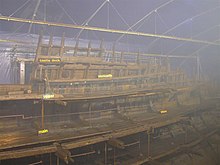
After finding the vessel Mary Rose objects and what was left of the ship were placed in a passive storage which slowed down the process of immediate deterioration removing the vessel from its extreme environment. In 1994, an elaborate three phased conservation treatment began on Mary Rose. From 1993 to 2003 was the first phase that consisted of the wood getting sprayed with low-molecular-weight PEG to replace the water in the cellular structure of the wood. The second phase from 2003 to 2010, raised the molecular-weight of the PEG solution with the purpose to strengthen the outer surface layers. The third phase in 2016, included controlled air drying.[12]
Vasa

The Vasa is a Swedish 1628 ship found archaeologically and was very well preserved. Completely submerged for 333 years allowed for the wood to be completely waterlogged but pollution in the 20th century off of the city Stockholm was able to kill any microorganisms that would have feast on the wreck, like the shipworm. The Vasa was sprayed with a PEG solution for 17 years followed by a period of drying which is still currently happening.[13]
| This article uses material from the Wikipedia article Metasyntactic variable, which is released under the Creative Commons Attribution-ShareAlike 3.0 Unported License. |